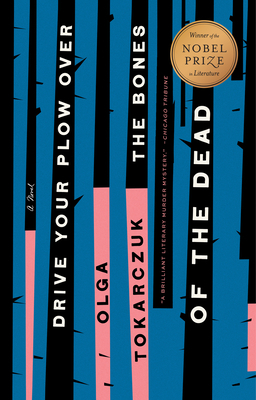
Drive Your Plow Over the Bones of the Dead
by Olga Tokarczuk (Translated by Antonia Lloyd-Jones)
Review:
Sorry for the formatting change but I just have to strongly disrecommend this book, especially for this challenge. I found this book to be highly problematic and I do not think it is a good represention of Poland. It seems that Tokarczuk is very controversial in Poland from the discourse I have seen online.
Click to open my full review where I go into the details of why I do not recommend this book. Author(s) from:
Poland
Setting:
Remote Polish village near the border with Czechia
Original Language:
Polish
First Publised:
2009
Prizes:
Olga Tokarczuk has won the Noble Prize for Literature (though I cannot understand why).
Description:
In a remote Polish village, Janina devotes the dark winter days to studying astrology, translating the poetry of William Blake, and taking care of the summer homes of wealthy Warsaw residents. Her reputation as a crank and a recluse is amplified by her not-so-secret preference for the company of animals over humans. Then a neighbor, Big Foot, turns up dead. Soon other bodies are discovered, in increasingly strange circumstances. As suspicions mount, Janina inserts herself into the investigation, certain that she knows whodunit. If only anyone would pay her mind . . .
A deeply satisfying thriller cum fairy tale , Drive Your Plow over the Bones of the Dead is a provocative exploration of the murky borderland between sanity and madness, justice and tradition, autonomy and fate. Whom do we deem sane? it asks. Who is worthy of a voice? (I would say that it is deeply unsatisying, not a thriller, and does not really explore any of these topics or questions.) Context:
The main character's name Janina is pronouced as Yanina. The book briefly touches on: (1) mushroom picking, which is a big thing in Poland. Poland's National Epic "Pan Tadeusz" tells the story of the dying culture of the Polish nobility and how they go mushroom picking and bear hunting. (2) Poland's population being around 75% Catholic and Catholism's Saint system. Some view Janina as the presentation of modern Poland going against traditional Poland, but yet they are very similar. (Credit to @wwadisanda's comment on YouTube)
Other Books by the Author(s):
She has other books but due to the highly problematic things I encountered in this book, especially #1 and 3 in my review, I will not be linking those here as I would never read from this author again.
Other Recommendations
Drive Your Plow Over the Bones of the Dead
Review
Read: May 6-11, 2026
I honestly cannot understand the positive reviews this book has received. It feels like they must have read a completely different book. Let's dive into my thoughts from worst (and most problematic) to best.
1) Not once but TWICE the author compares hunting and eating meat to the horrors of concentration camps and the holocaust. To equate hunting and eating meat with a tool for genocide that was used to murder millions of people is truly abhorent and insensitive. It was shocking that these types of remarks were being made and the fact that I have only seen one person comment on these remarks in the many reviews I have read is baffling.
"When you walk past a shop window where large red chunks of butchered bodies are hanging on display, do you stop to wonder what it really is? You never think twice about it, do you? Or when you order a kebab or a chop - what are you actually getting? There's nothing shocking about it. Crime has come to be regarded as a normal, everyday activity. Everyone commits it. That's just how the world would look if concentration camps became the norm. Nobody would see anything wrong with them" (page 105).
"Now it seemed clear to me why those hunting towers, which do after all bear a strong resemblance to watchtowers in concerntration camps, are called 'pulpits'" (page 242).
2) This bring my next issue with this book - the constant, heavy-handed, and non-nuanced discussion around hunting and eating meat.
Yes, the men in this book were very problematic and should be critized. Not only are they very sexist, but in terms of their treatment of animals they are poaching, running a fox fur farm, killing dogs, and taking photos celebrating all the animals they have killed. These are all things that are reprehensible and awful. However, the book refuses to acknowledge that ethical hunting does exist and eating meat can be an important part of health and survival. Someone can hunt and/or eat meat while still valuing animal lives and caring about them.
Some may hunt purely for sport (and that is definitely worthy of being criticized), but there are many who hunt who understand the responsibility of the act. They do so to ensure their (and their family's or community's) survival. They make sure that the animals do not suffer. They honor each life they take, feeling its weight, and not letting any part of the animal go to waste nor taking more than they need. Humans have been hunting for centuries and there are many great examples available to us of ethical hunting.
In the reality show, Alone, we see people grapple with the responsibility of taking animal lives for their survival (and we can see that survival off of plants alone is not possible). In Volume 6 of the Chef's Table on Netflix, we meet Dario Cecchini, an Italian butcher who shows us that caring about animals and eating meat are not mutually exclusive. Charlotte McConaghy's book, Once There Were Wolves, shows the devastating impact to the environemnt of uncheck populations due to lack of predators, and thus can help us understand the role hunting can play in population control. And in terms of eating meat, researching regenerative agriculture, you can see how livestock animals play an important role in our food system and actually help the environment through soil regeneration and carbon sequestration (this of course does not apply to feedlots which are unethical and harmful).
Coming back to the problems with the book, Tokarczuk tries to equate hunting and poaching: "To tell the truth, I have never understood the difference between 'poaching' and 'hunting.' Both words mean killing" (page 255). It is made clear in the book many times, that Tokarczuk believes hunting should be illegal. However, these two acts are very different. Poaching involves illegally snaring and killing animals. There is a clear lack of care about nature and animals. It is all about the poacher's gain. There are hunting seasons and laws for a reason. It is to ensure that we do not take too much from the land and the populations of animals remain in balance. Sustainability is baked into it. Look up "hunting vs poaching" and it will become clear that these 2 acts are very different.
My last point on this, is that animals will die regardless of whether you eat meat (something discussed in the death per calorie argument). Most plant-based foods you buy from the grocery store are grown via large-scale agriculture (and mainly via monocropping), which is not only bad for the environment but also results in many animals deaths - animals get poisoned from pesticides, crushed under farm equipment, and their habitats get destroyed. Yet, we do not seem to care about this as a society.
People can make their own personal choices on this topic, and that is not an issue. But when a book, especially with so much recognition, removes all nuiance from the subject and acts like anyone who hunts and eats meat is a terrible person, it's a problem. (Side note: I really have to wonder what the main character fed her dogs and how she felt about predatory animals...are they evil to in her eyes because they kill other animals?)
3) The second chapter is called "Testosterone Autism" which references a "theory" that the main character explains in it...it is just as problematic, insensitive, and abelist as it sounds.
4) I typically like an unlikeable main character but Janina was actually the worst and I could not stand her. In the end, there does not seem to be a point to any of it. How other people seemed to have loved her escapes me.
It feels that the only purpose her insufferability served was
And with that the book loses all its meaning and it is unclear what it is trying to say. Should we listen to anything she has said considering
And in the way that it was done, it ruined one of the things I actually liked that the author was doing. Janina throughout the book kept pointing out how the people, particularly men, dismiss her as crazy or a madwoman. And you see them writing her off, ignoring her, and just generally being sexist. This is such a relatable experience to many women. And then the author creates moments where you as the reader start to wonder if she crazy and it is very confronting to be put into those shoes. However, where it all falls apart is that
5) The weird capitalization of words that maybe are supposed to reference William Blake's writing, serves no real purpose. In fact, the mentions of William Blake throughout the novel adds little to nothing to it...nor does all the rambling about astrology.
6) There were a few quotes and passages that I did enjoy and that posed interesting ideas, though these are not explored in a meaningful way, making them feel shallow.